Increasing Home Ownership Will Spark a Conservative Revival

We have to address the honest economic anxieties of our youngest voters. We need to ensure they become a generation of owners, not renters.

Opinion by Shane Harris, Editor in Chief of AMAC Newsline - Monday, August 4, 2025

Back in May, I argued that the growing crisis of housing unaffordability was the most potent threat to the American Dream. Now, major voices on the political right are recognizing that fact as well, also highlighting how making homeownership more attainable for more people is a crucial step in preserving the vitality and longevity of the conservative movement.

Independent commentator and former Fox News host Tucker Carlson thrust the issue into the mainstream during remarks at a Turning Point USA conference last month. Carlson’s comments about Jeffrey Epstein garnered the most headlines, but by far the most important part of his speech concerned housing unaffordability and how that crisis is driving a generational collapse of confidence in our entire economic system.

This section of Carlson’s speech is worth quoting at length:

“Basic economics really matter. They matter because, not that it’s bad that rich people are getting richer. It’s bad that everyone else is getting poorer. And it’s especially bad that young people can’t afford homes.

Let me just put a very precise point on this. If you want a measure of how your economy is doing, I personally favor eliminating GDP as a measure. I don’t even know what that is. It’s clearly not relevant.

They tell me Japan has a stagnant GDP. Have you been to Tokyo? It’s the single most radicalizing experience you’ll ever have. Because it’s just so nice. You lost the war, really? Can we lose the war and wind up like this?

GDP. No. I don’t know what even that is. Total economic activity, no, no. My measure’s really simple. I got a bunch of kids. Can they afford houses with full-time jobs at like 27, 28? The answer is, no way.”

Even many avowed Carlson critics on the left begrudgingly acknowledged how accurate his diagnosis of the problem is. For all the obscure economic data that leaders in both parties are so eager to shove in the faces of the public, they can’t solve the riddle of why a young person who goes to college, gets a good job, and shows up to work every day can’t afford to purchase a home to raise his or her family in – and they have shown no real indication that they are able to reverse that trend.

Turning Point founder Charlie Kirk put an even finer point on what this means for the conservative movement in a post on X:

“The next generation is primed for a permanent CONSERVATIVE political realignment – the most dramatic realignment we’ve seen since Woodstock. But it’s not guaranteed.

We have to address the honest economic anxieties of our youngest voters. We need to ensure they become a generation of owners, not renters. If we don’t, there will be more Zohran Mandanis, Omar Fatehs, and Abdul El-Sayeds.

The populist energy in America will either flow into MAGA populist conservatism that restores the American Dream, or racial grievance-driven, free-stuff socialism that destroys it.

It’s a race against the clock. We have 3.5 years to deliver, and if we do, we will change the course of American history for the better. We must deliver.”

Kirk is spot on here – the “economic anxieties” he mentions are a latent radicalizing force that will upend our politics, economy, and culture. The political movement that best channels and addresses those concerns stands to become the ascendant political power in the United States.

America stands at a crossroads. If conservatives present the clearest answer to young people for how they can have a stable, prosperous, and independent future – a dream defined by homeownership – then the conservative movement is primed for a revival that will usher in a return of the traditional values that first made this country an economic powerhouse. Alternatively, if the Marxist vision advanced by the likes of Zohran Mamdani wins out, the country may be doomed to repeat the failures of every other socialist state throughout history.

Seemingly with each passing month, the statistics on homeownership become more disheartening. The median home sale price reached a new all-time high of $435,300 in June even as sales slumped, indicating that some buyers may be giving up on the dream of homeownership altogether. The median age of a first-time homebuyer was 38 in 2024, up from 29 as recently as the 1980s.

Perhaps most astonishingly, the average income required to afford a single-family home has risen by 60 percent since just 2021. As I wrote earlier this year, in 1985 the median household income in the United States was about $22,400, while the median home price was $78,200 – a price-to-income ratio of 3.5. By 2022, the price-to-income ratio for a new home had skyrocketed to 5.8.

Wall Street Journal opinion columnist William Galston offered some potential solutions in a thoughtful column earlier this month. Some of them hold promise, such as regulatory reforms to reduce closing costs and “a sustained program of fiscal restraint” to bring down interest rates.

But other supposed solutions Galston offers only underscore how the housing unaffordability crisis became so bad in the first place – and why the conventional wisdom from the political establishment isn’t going to solve it. Most egregiously, Galston argues that the United States should “change its immigration policy to ensure the adequate supply of labor for the construction industry.”

Really? That sort of “amnesty lite” talk should enrage every American who understands that allowing in millions of migrants was a major reason why houses became so unaffordable. In addition to undercutting American wages and destroying the domestic construction industry, flooding the country with low-wage workers created a supply crunch that sent prices soaring.

Galston also fails to mention a major problem that lawmakers have an obligation to address: big banks buying up millions of homes and outbidding everyday Americans. In 2022, investment banks bought one of every four homes sold, many of them purchased with cash and over asking price. In the first three months of 2025, nearly 27 percent of homes sold were bought by investors. That’s 265,000 homes that could have gone to American families.

Free-market purists will cry that government intervention in the housing market smacks of a socialist command economy. But the reality is that big banks are using anti-competitive practices to drive the dream of homeownership out of reach for everyday families, intentionally turning America into a nation of permanent renters. Republicans today should adopt the trust-busting conservative mentality of Teddy Roosevelt a century ago to address this threat.

Promoting homeownership is essential to the future of the conservative movement – and the country. More than just financial security, homeownership fosters stability, responsibility, and long-term thinking. When people own homes, start families, and put down roots, they develop a stake in preserving what they have built. They have something to conserve.

A nation of homeowners is a nation invested in the future. Property owners are more likely to vote, to care about schools and public safety, and to resist the pull of radical ideologies that promise destruction rather than renewal. This is the cultural backbone of a healthy society built on ownership, not dependence.

If conservatives lead on this issue, they can win over a generation desperate for stability and direction. But if nothing changes, the movement risks surrendering to a vision of dependency and decline.

Shane Harris is the Editor in Chief of AMAC Newsline. You can follow him on X @shaneharris513.

Restoring American Culture

“We will begin the complete restoration of America and the revolution of common sense. It’s all about common sense.”

 - Editor, The New Criterion

Throughout his presidential campaign, Donald Trump declared that he and his supporters were “the party of common sense.” In his Inaugural Address on January 20, Trump returned to this theme. With his flurry of executive orders, he said, “We will begin the complete restoration of America and the revolution of common sense. It’s all about common sense.”

I agree. But what is “common sense”? At the beginning of his Discourse on Method, René Descartes said that common sense was “the most widely distributed thing in the world.” Is it? Much as I admire Descartes, I have to note that he was imperfectly acquainted with the realities of 21st century America. If he were with us today, I am sure he would emend his opinion.

After all, is it common sense to pretend that men can be women? Or to pretend that you do not know what a woman is? During her confirmation hearings, a sitting member of the Supreme Court professed to be baffled by that question.

Is it common sense to open the borders of your country and then to spend truckloads of taxpayer dollars to feed, house, and nurture the millions of illegal migrants who have poured in? Is it common sense to sacrifice competence on the altar of so-called diversity? To allow politicians to bankrupt the country by incontinent overspending? That’s the start of a list one could easily enlarge.

In the cultural realm, is it common sense to celebrate art that is indistinguishable from pornography or some other form of psychopathology? Is it common sense to rewrite history in an effort to soothe the wounded feelings of people who crave victimhood? Is it common sense to transform higher education from an institution dedicated to the preservation and transmission of the highest values of our civilization into a wrecking ball aimed at destroying that civilization?

Continue reading this article at IMPRIMIS

This article is adapted from a talk delivered on January 29, 2025, at Hillsdale College’s Blake Center for Faith and Freedom in Somers, Connecticut.

Roger Kimball is editor and publisher of The New Criterionand publisher of Encounter Books. He earned his B.A. from Bennington College and his M.A. and M.Phil. in philosophy from Yale University. He has written for numerous publications, including The Wall Street Journal and The New York Times Book Review, and is a columnist for The Spectator World, American Greatness, and The Telegraph. He is author or editor of several books, including The Long March: How the Cultural Revolution of the 1960s Changed America, The Rape of the Masters: How Political Correctness Sabotages Art, and Vox Populi: The Perils and Promises of Populism.

Part-time Illinois Dems Give Themselves a Raise....AGAIN

Why do we pay nearly $100K in salary

for each Illinois lawmaker?

By: Ted Dabrowski & John Klingner - WIREPOINTS

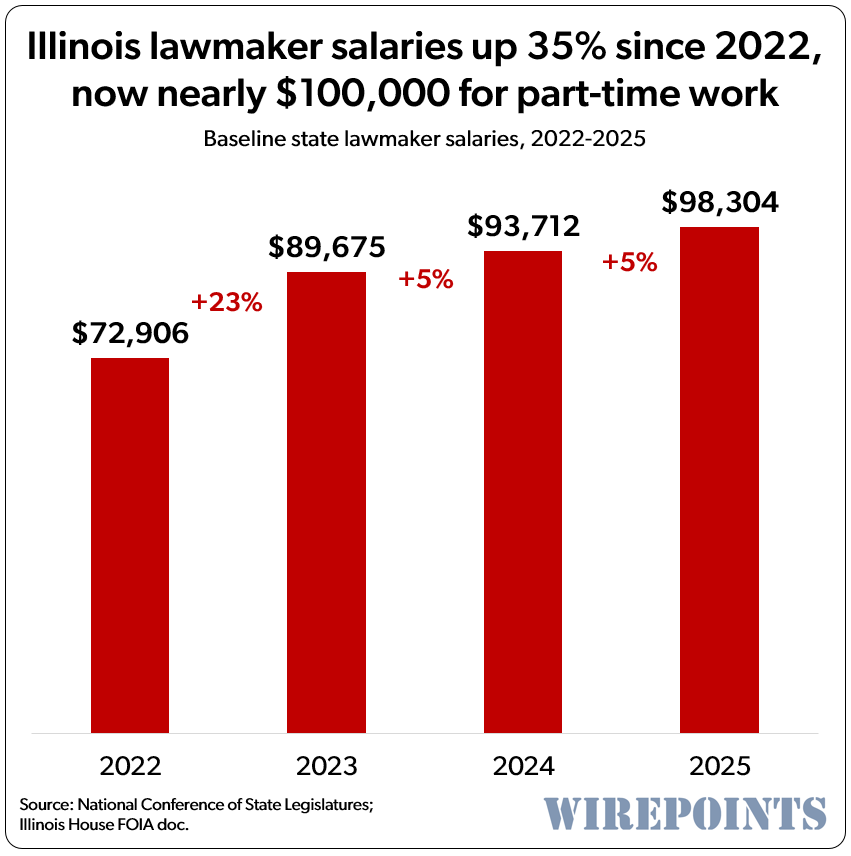
We didn’t opine on the nearly $5,000 raise lawmakers gave themselves at the time they passed their record-sized $55.2 billion budget, but we can’t leave it unaddressed. Democrats in both chambers voted unanimously for the budget and by extension, their own raises, while every Republican opposed both measures

Our politicians don’t deserve any raises at all. Certainly not after they just hiked taxes and increased costs on a slew of things at the beginning of July. Gas taxes are higher. It’s the same for gaming and tobacco products. And rideshare services. Companies, too, are seeing their taxes go up again. After they jumped $1 billion the year before. 

Our lawmakers are actually going the wrong way on competitiveness as states across the country cut their tax rates. 26 states have cut their personal income tax rates since 2021 (see Appendix).  

Yet Illinois lawmakers are now paying themselves nearly $100K for what’s considered by most to be part-time work. In total, their base pay has jumped 35% since 2022.

Add in additional stipends worth up to $30,000 for House and Senate leadership positions and a large portion of lawmakers receive far more than $100,000 annually.

Remember, these are the same lawmakers that have done nothing to provide Illinoisans with property tax relief. Property taxes have risen by several billion dollars in total over the past few years and Illinoisans continue to pay the nation’s highest property taxes. 

They’re also the same lawmakers that locked-in automatic increases to the state’s motor fuel tax, which they doubled in 2019.

The same ones that made sure public unions get the most-protected powers and benefits in the country.

The same ones that pass laws that strip voters of their rights, like the one recently used by the Effingham School District to try and bypass a taxpayer referendum.

Illinois lawmakers have destroyed affordability. And ditto for the state’s job creation and economy.

Such a terrible job performance deserves pay cuts, not raises.

A final note. Lawmakers don’t deserve all the blame. Gov. Pritzker has signed off on all of the above.

###

Illinois moves over $300M out of road fund as infrastructure crumbles

Illinois' latest budget diverts millions in infrastructure funds to cover structural budget deficits, despite substandard road conditions.

Illinois Policy - Ravi Mishra - July 2, 2025

Despite Illinois’ poor road conditions, Gov. J.B. Pritzker’s 2026 budget will take $308 million from the state’s dedicated road building and repair fund to fix short-term budget gaps.

That includes $171 million in motor fuel tax revenues that were supposed to go to the Road Fund but are being diverted for other state spending. The money was intended to finish Pritzker’s $45 billion Rebuild Illinois infrastructure plan launched in 2019 to fix roads, bridges, railways and airports.

That plan launched a slew of new taxes to pay for the infrastructure, including doubling the state gasoline tax that is now being diverted. It also contained at least $1.4 billion in pork projects, including dog parks, pickleball courts and renovation of a shuttered theater.

And while lawmakers and Pritzker had to rob the Road Fund to prop up their spending plans, they were able to stuff $237 million in pork projects in the new budget, but just for Democrats. That means 1 in 3 taxpayers was left out.

Pritzker just last year reaffirmed his commitment to his infrastructure plan: “Rebuild Illinois has been among my highest priorities since I became governor, after years of neglect and disinvestment that held back our state’s growth.”

Another $137 million was taken from the Road Fund to cover state employee health benefits. State leaders said the move complies with provisions that allow the Road Fund to be used for payments towards “expenses related to workers’ compensation claims for death or injury,” including health care.

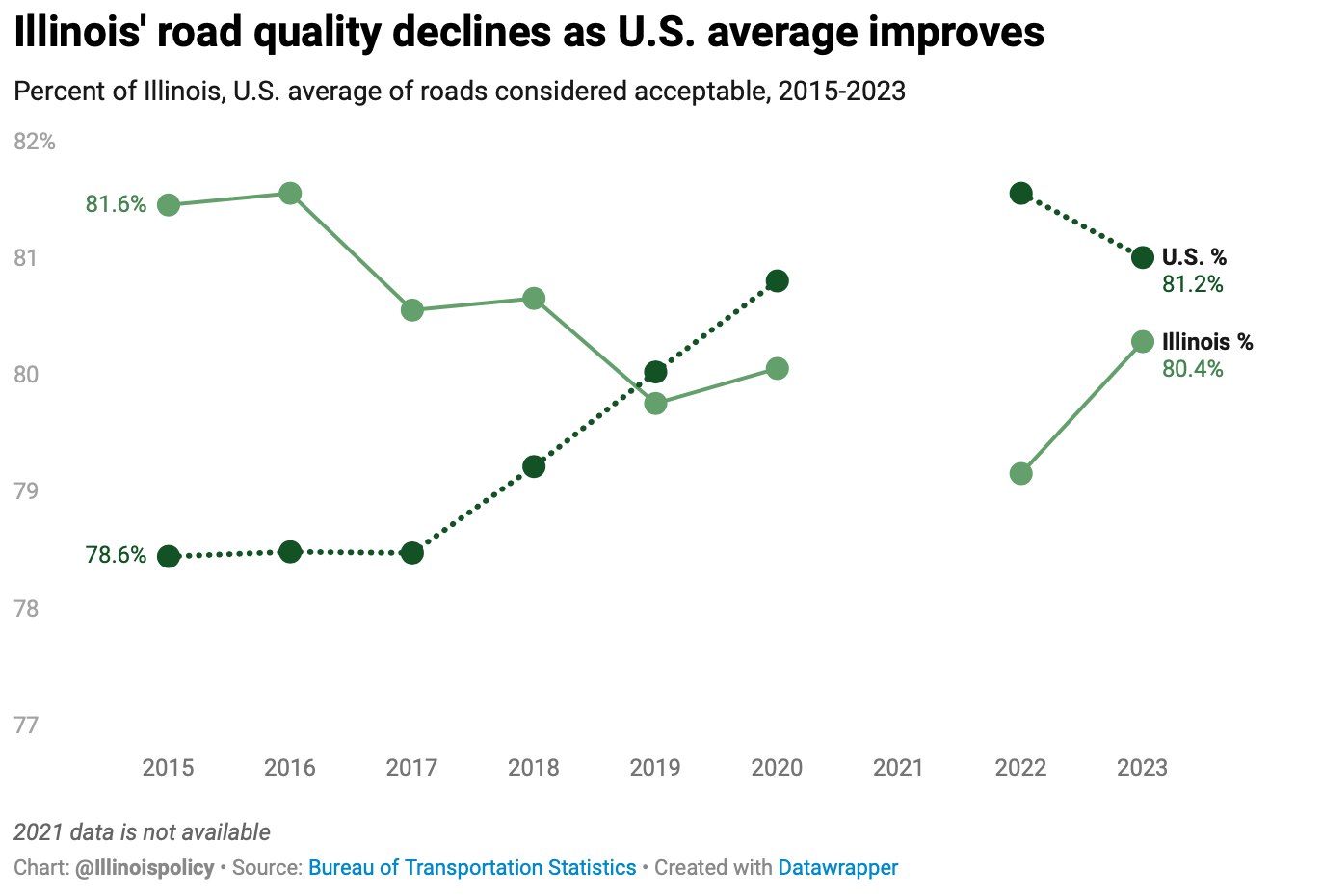
These funding shifts come as Illinois ranks just 31st in road quality. U.S. Bureau of Transportation data shows as of 2023, only 80.4% of Illinois’ roads were in acceptable condition, a minimal change since 2015 despite all Pritzker’s spending. The national average is 81.2%, but other Midwestern states such as Indiana, Iowa and Minnesota maintain conditions above 90%.

Lawmakers continue to prioritize gimmicks and short-term solutions as analysts warn these moves can weaken Illinois’ long-term infrastructure funding. Investing in road infrastructure is a crucial part of economic development, as Pritzker said. Maintaining proper funding can enhance trade and commerce, boost tourism, improve connectivity, create jobs and improve property values.

This is nothing new in Illinois. Lawmakers have long used the Road Fund as a piggybank for unrelated expenses, a move that voters overwhelmingly tried to block. In 2016 they approved the “lockbox,” a constitutional amendment which was supposed to protect transportation revenues from lawmaker pilfering. Despite this voter mandate, lawmakers have continued using workarounds such as delayed transfers and reclassifying spending.

If Illinois wants to be serious about improving infrastructure, it must stop misusing dedicated funds. Adopting a performance-based budgeting model such as Minnesota’scan help the state plan and preserve necessary funding for road and bridge maintenance. This model ensures infrastructure money is spent on need, value and measurable outcomes, rather than politics.

The state also needs to structurally balance its budget rather than relying on short-term fixes. The state should adopt reforms from the Illinois Policy Institute’s Illinois Forward plan, including strict budget caps to match taxpayer income growth and necessary cuts to discretionary programs. These measures would reduce pressure to divert infrastructure funds to fill recurring budget deficits.

###


Is J.D. Vance Right About Europe?

  - Claremont Review of Books

The following is adapted from a speech delivered on April 25, 2025, at a Hillsdale College National Leadership Seminar in Kansas City, Missouri.

Vice President J.D. Vance’s first major assignment from Donald Trump was to join a bunch of European leaders who thought of themselves as our close allies—and to read them the riot act. This happened at the Munich Security Conference on February 14. Instead of discussing armaments and armies, Vance said: “The threat that I worry the most about vis-à-vis Europe is not Russia. It’s not China. It’s the retreat of Europe from some of its most fundamental values.” Europe, according to Vance, had become hostile to free speech. It was hostile to free speech because it was hostile to democracy. And you could measure its hostility to democracy by the fact that for 50 years European voters had kept asking for less immigration and had kept getting more of it. Vance admitted that it reminded him a bit of the United States.

Is Vance right about Europe and the West more generally?

Vance is certainly right that the Europeans’ situation resembles ours. Europe is split between two camps: so-called “populists” and “elites.” (Neither of the two camps has a name for itself, so—without any ill will—we’ll use the names applied to each by their foes.) The difference between here and there is that for the second time in three elections, populists have now taken power in the U.S. In Europe they have a harder time, ruling only in Italy, Slovakia, and Hungary.

As Vance sees it, that’s because Europeans have worked to make populist victories impossible. He has been particularly critical of Germany. In February, the main anti-immigration party there, the Alternative for Germany (AfD), became the country’s second-largest, close behind the Christian Democrats. The Social Democrats, who are one of the most successful political parties of modern times, have been contending for power in Germany since the middle of the 19th century. The AfD has now left them in the dust. And yet the AfD was kept out of the Munich Security Conference, so Vance went out and met with their leader, Alice Weidel. In so doing, he waded into a live controversy.

German progressives argue that ostracizing the AfD is necessary—even if it means excluding the AfD from legislative functions to which they are constitutionally entitled as the largest opposition party. Otherwise Germany risks repeating the horrors of Nazism. The AfD’s supporters counter that their party was founded in 2013 by a bunch of macro-economists concerned about German bailouts of deeply indebted European countries. It can have little to do with the Nazis. Of the war criminals long tracked by the Simon Wiesenthal Center, only three appear to be still alive, all of them about 100 years of age. Not much to build a revanchist movement around. And yet efforts to police Nazism have suddenly taken on a new life, ten decades after Nazism’s founding and eight decades after its defeat.

Continue reading this article on IMPRIMIS

CNN Admits: Tariffs AREN'T Raising Prices

CNN, MSNBC, CBS, NBC, ABC: 'The sky is/was falling'

Admission Comes After 5 Articles Insisting Tariffs Were Raising Prices

“Prices would rise — sharply — they said, reigniting an inflation crisis that tens of millions of Americans had elected [President Donald Trump] to solve,” CNN’s David Goldman wrote on Friday. “But that massive, tariff-induced inflation spike hasn’t materialized. Not even close.”

Indeed, it hasn’t. But who exactly is Goldman referring to when he says, “they said”? Well, Goldman might want to check his own newsroom.

On May 16, CNN’s Allison Morrow wrote, “There’s no denying it now: Tariffs are raising prices.”

“Donald Trump’s pitch to Americans on the campaign trail last year included a simple (and simplistic) promise: lower prices on Day One. Even if he didn’t mean it literally, it’s now Day 115, and the results of his only significant economic policy show that the opposite is happening,” Morrow wrote.

Three days prior, CNN’s Nathaniel Meyersohn wrote, “Tariffs have already made mattresses, strollers and power tools more expensive.”

Some other doomsday predictions from CNN include Auzinea Bacon’s May 24 article titled “These companies will raise prices because of Trump’s tariffs,” accusing Trump of giving “many Americans whiplash” as companies announced “daunting” price hikes. “Anything from groceries and clothing to toys and cars could cost Americans more,” Bacon wrote.

Samantha Delouya warned Americans their Memorial Day “cookout might be more expensive this year — thanks to tariffs.” In April Elisabeth Buchwald wrote, “Here’s what could soon cost you a lot more because of Trump’s massive tariffs.”

“President Donald Trump on Wednesday launched a US trade war with every country via a barrage of tariffs that are set to go into effect almost immediately. American consumers and businesses stand to pay a hefty price for that battle,” Buchwald said. “For the first time since Trump’s return to the Oval Office, it’s not a question of what could get more expensive due to tariffs but rather a matter of when.”

But as Goldman wrote on Friday, those “tariff-induced inflation spike[s]” didn’t materialize. As cited by Goldman, consumer prices rose just 2.4 percent annually in May: “That was less than economists had expected, and only slightly higher than the 2.3% rate in April, which was the US economy’s lowest inflation since February 2021.”

In fact, core inflation (which excludes things like food and gas prices) fell to 2.5 percent in April.

“That was the lowest reading since March 2021,” according to Goldman. “Tariffs through mid-June haven’t caused inflation to spike. Love tariffs or hate them, there’s no denying inflation is lower now than when Trump took office.”

Goldman floats the idea that some industries are still coasting on pre-tariff inventories. But even he can’t deny the facts.

“That’s a far cry from what economists and consumers have predicted,” he continued. “So what happened? Are economists just really bad at their jobs?”

Maybe. But if Goldman wants solid answers to questions about the economy and prices, he’d do well to avoid the CNN newsroom, where his colleagues spent weeks forecasting economic catastrophe. It turns out that the people igniting inflation fears the most were the so-called journalists reporting on them.

Brianna Lyman is an elections correspondent at The Federalist. Brianna graduated from Fordham University with a degree in International Political Economy. Her work has been featured on Newsmax, Fox News, Fox Business and RealClearPolitics. Follow Brianna on X: @briannalyman2

Tariffs in American History

 - Author, An Empire of Wealth: The Epic History of American Economic Power

Tariffs are among the oldest of taxes for the simple reason that they are easy to collect. Just send in the tax collectors and don’t let the goods being transported move until the duty has been paid. Being one of the earliest forms of taxation, it is not surprising that tariffs produced one of the earliest forms of tax evasion: smuggling.

In America’s colonial period, the east coast of the United States, with its many rivers and inlets that the small ships of those days could utilize, lent itself to smuggling, and the American colonists evaded British tariffs on a grand scale.

Indeed, Rhode Island, with its long coastline relative to the area and its many small harbors, was the epicenter of colonial smuggling, and it opposed any attempts to suppress it. Rhode Island was the first colony to foreswear allegiance to Great Britain, on May 4, 1776, two months before the Declaration of Independence. It was also the only state not to send delegates to the Constitutional Convention in Philadelphia in 1787, fearing that a stronger federal government, empowered to tax, would suppress smuggling. And it was the last state to ratify the Constitution, on May 29, 1790, more than a year after the federal government had come into existence. It did so then only under the threat of having its exports taxed as if from a foreign nation.

Continue reading this article on IMPRIMIS

This article is adapted from a lecture delivered in Washington, D.C., on May 6, 2025, as part of the AWC Family Foundation Lecture Series. Sponsored by Hillsdale College’s Allan P. Kirby, Jr. Center for Constitutional Studies and Citizenship, which is undergoing extensive expansion and renovation, the lecture was delivered in The Heritage Foundation’s Van Andel–Gaby Center.

Mark Batinick: Illinois is paying top dollar to fail its college-age young adults

Illinois students deserve better from their state

Op-Ed submitted by Mark Batinick - Chicago Tribune - May 28, 2025

When my first kid started looking at colleges, I had one goal: Get them a great education at a price we could afford. As a proud University of Illinois alum, I thought the flagship school of my own state would be a natural choice.

Then I saw the price tag. I was stunned to realize it was not affordable anymore.

That’s the reality for thousands of Illinois families who discover in-state tuition has skyrocketed 49% since 2007. With the sixth-highest in-state tuition in the nation, sending students to an Illinois university now costs most families more than sending them out of state.

So, those young people leave. In 2021, nearly 48% of Illinois’ four-year, college-bound students chose schools elsewhere. They take their knowledge, income and tax dollars with them — often for good.

What’s maddening is how completely unnecessary this is.

We’re told Illinois universities are expensive because they’re underfunded. That seems to be the narrative every time tuition increases make headlines. But it doesn’t speak to the larger problem. While the Urbana-Champaign campus continues to see record attendance, the state’s regional universities are struggling to define their roles and demonstrate unique value. Enrollment across the 12 public universities fell from around 368,000 in 2009 to 278,000 in 2023 — a 25% drop — but the money keeps flowing.

Despite a shrinking student population, Illinois ranks No. 1 in the nation in higher education spending per full-time student at $22,590 — roughly double the national average.  Much of it is getting swallowed by pension payments. Analysis from the Illinois Policy Institute finds that in 2009, only 7 cents of every higher education dollar went to faculty pensions. Today, it’s many times that.  

But strip out pension costs, and Illinois still ranks third nationally in per-student spending. We’re not being stingy; we’re being inefficient.

That’s the real problem. Illinois makes everything more expensive: building buildings, running schools and hiring staff. When campuses need to redo road infrastructure, they pay $98,386 per lane-mile, which is double the cost for Minnesota, according to the Reason Foundation, a libertarian think tank. Prevailing wage laws, inflated procurement rules, lawsuits, bloated administrative payrolls — the whole system is weighed down by costs that have nothing to do with education.

The result is predictable. Tuition rises to cover the gaps. Taxpayers pick up the tab. And students head to other states instead of shelling out in Illinois.

The conservative think tank Wirepoints estimates that we now spend over $300,000 to educate each child from kindergarten through high school, only to watch them take a scholarship to Missouri, Indiana or Arizona. Then they get a job, buy a house, pay taxes and raise a family elsewhere. Illinois loses a college-educated taxpayer after we invested in that student for at least 12 years.

That’s not just wasteful. It’s self-destruction. It’s the Illinois model: Spend more, get less, repeat.

We can’t keep doing this. Illinois families deserve affordable, high-quality education without having to consider an out-of-state trip in a U-Haul as part of the college application process. We don’t need to spend more. We need to spend smarter. We need universities that compete and lawmakers who want to prioritize reforms.

Until then, don’t blame young adults for leaving. Blame the system that gave them every reason to go.

###

Mark Batinick, a Republican, served in the Illinois General Assembly from 2015 to 2023, representing the 97th District. He is the pensions policy adviser for the Illinois Policy Institute.

Editorial: Believe it or not, (Democrats) Springfield is mulling a jobs tax

People talk at the Illinois State Capitol on Feb. 21, 2024. (Brian Cassella/Chicago Tribune)

By | Chicago Tribune

In a state where one of the only job sectors that’s growing is the government, it’s a terrible idea to implement a new tax that hits private-sector employers and workers hard. 

That’s what the payroll tax being considered in Springfield would do

State Sen. Ram Villivalam, D-Chicago, wants to adopt a state payroll tax to do something that sounds good — cover paid family and medical leave. Called the Paid Family and Medical Leave Insurance Program Act, Villivalam’s legislation would impose a new tax based on a worker’s wages and would be withheld automatically from paychecks, just like Social Security and Medicare. Both the employee and the employer would have to contribute toward this payroll tax.

Last month, the state Senate extended the normal deadline for considering the bill, suggesting there’s some momentum.

Revenue from the program, which would impose a 1.12% tax on paychecks (paid in part by the employee and in part by the employer), would fund benefits in a state-managed paid leave program, giving workers up to 18 weeks of paid family/medical leave each year, plus up to nine extra weeks for pregnancy. The tax would take effect Jan. 1, 2027, for employers with 25 or more workers.

Initially, the tax would apply at companies employing at least 25 people, but by 2029 all employers, no matter how small, would be affected.

Sounds good, right? Unfortunately, as with all new taxes, this one is all but sure to rise with time. Consider Minnesota, which is launching its own leave program and payroll tax. In 2023, legislators enacted a 0.7% payroll tax to take effect in 2026. The tax hasn’t even hit employers yet, but lawmakers already have boosted the rate to 0.88% since then.

If times were better in Illinois, a proposal like this might be worth considering, given the struggles new parents face. It’s especially egregious that many women, lacking federal paid leave or job protection, are forced to return to work just a few weeks after giving birth — or risk losing their jobs. But times aren’t good, not for the state’s economy or its finances — which continue to be plagued by $144 billion in pension debt and yearly budget deficits.

There’s already a major jobs issue in Illinois, where private-sector job creation is virtually stagnant. As of the end of last year, Illinois gained a net 32,000 nonfarm jobs since the end of 2019, just before the pandemic. 

But 73% of them were government jobs. That’s not a recipe for a strong economy. 

A state payroll tax would punish businesses for … hiring people, something we desperately need them to do. While intended to help workers afford time off for health and family reasons, it would increase the cost of hiring and maintaining jobs here and expose both employers and employees to future tax hikes if the program runs deficits. 

In other words, it’s possible that the Paid Family and Medical Leave Insurance Program Actcould lead to fewer workers around to take advantage of paid leave.

The last thing Illinois should be doing right now is creating new disincentives to hiring.

###

There's another proposal in Springfield to tax motorists by the mile

 Illinoisans already pay the 2nd highest gas taxes in the nation behind only California.

By Dylan Sharkey - Asst. Editor - Illinois Policy

March 14, 2025

Illinois state lawmakers again want to tax drivers on each mile of road they use – an idea that lasted a week the last time they raised the idea.

With electric cars and cars being more fuel efficient, Illinois is not seeing as much revenue per vehicle, so state lawmakers are considering a vehicle miles traveled tax to raise more money from motorists. State Sen. Ram Villivalam, D-Chicago, proposed legislation exploring a “road usage charge” to tax drivers by the mile.

The tax might involve transponders, meaning the taxman would be tracking a driver’s movement. Or a photo of the odometer could be sent. Both gas and electric vehicles would be part of a 1,000-vehicle test of drivers who volunteer to be taxed based on miles driven, and possibly on the time of day they use roads. The move would target   Illinois drivers who don’t pay the gas tax by driving electric cars or use less gas because their vehicles are efficient.

Proponents say electric vehicle drivers should contribute more than they are to funding roads. Electric vehicle license plate renewals are $251 compared to $151 for a gas vehicle. The pilot program would incentivize EV drivers to join with a discount on annual registration.

Since Gov. J.B. Pritzker doubled the gas tax in 2019 and built in automatic annual increases so lawmakers would no longer vote on the unpopular taxes, the amount drivers pay in gas taxes has reached roughly $2 billion. Illinois drivers pay the second-highest gas taxes in the nation, behind only California.

Illinois last discussed a VMT tax in 2019, but the bill’s sponsor drew so much ire that he pulled the bill a week later.

This effort, Senate Bill 1938, was being co-sponsored by state Sen. Christopher Belt, D-East St. Louis, but he pulled his name off the bill. It is assigned to the Transportation Committee, where it must receive a passing vote by March 21.

It’s hard to believe Illinois would ever be strapped for infrastructure cash. The state is going to spend $40 billion on roads, bridges and other infrastructure projects during a six-year span.

Another broken promise would be easier to believe. Illinoisans were once promised “Toll free in ’73,” meaning toll roads would eventually cost drivers nothing, but that never happened.

###