Editorial: Illinois Supreme Court’s refusal to hear gerrymandering case is a blow to democracy
The path to Democratic renewal is not through disenfranchising voters.

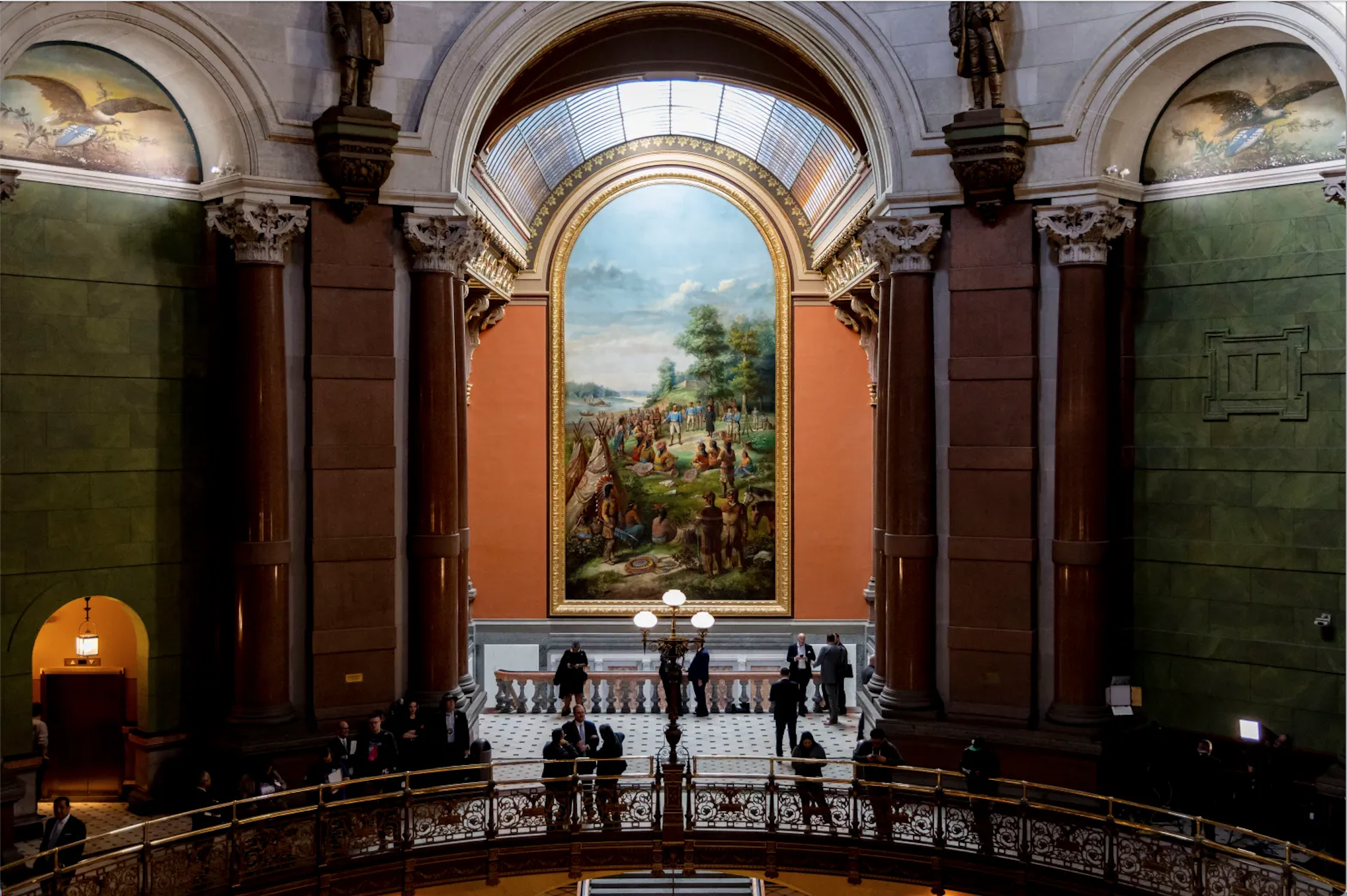
The Illinois Supreme Court Building in Springfield on May 8, 2024. (John J. Kim/Chicago Tribune)
Chicago Tribune Editorial Board - April 11, 2025
Last month, we urged Illinois Supreme Court justices to consider state Republicans’ strong arguments against extreme gerrymandering in the Land of Lincoln. To no one’s surprise, on Wednesday the Democratic majority on the high court seized on a technicality to avoid confronting the obvious and refused to hear the GOP’s case.
That leaves intact legislative maps that badly undermine democracy in Illinois. Any reasonable, non-partisan person looking at the facts would arrive at that conclusion. State House districts are so distorted that GOP candidates won 45% of the total vote for the Illinois House of Representatives in 2024 and just 34% of the seats.
That’s plain wrong, and the justices ought to be ashamed.
After multiple failed attempts in the past two decades to get a fair hearing before the Supreme Court, the GOP thought this time might be different. A lawsuit led by House Minority Leader Tony McCombie presented hard data, strong arguments that numerous bizarrely shaped districts violate the state Constitution, and even responded to court decisions in the past that had tossed GOP litigation because it was filed too close to an election.
Nothing doing.
The court refused to take up this latest case, not based on its merits but because the majority of justices said the plaintiffs waited too long to act. There’s no winning with this bunch, which appears content to oversee a judicial version of Joseph Heller’s Catch-22.
While Illinois’ high court declined to intervene, our neighbors to the north took a different, more encouraging path. Wisconsin’s Supreme Court contest between conservative Brad Schimel and liberal Susan Crawford recently garnered intense national attention as a referendum of sorts on the early months of the Trump administration. Crawford prevailed, which cheered Democrats and worried Republicans.
But even before that contest, Wisconsin’s high court had thrown out the Badger State’s gerrymandered maps, ruling in December 2023 that similarly distorted district boundaries favoring the GOP in that state were unconstitutional.
Equally as important, and to the surprise of many, Wisconsin Gov. Tony Evers in February 2024 compromised with the GOP-run legislature on new maps that are said to slightly favor the Republicans but are far fairer than the districts the court rejected. “Wisconsin, when I promised I wanted fair maps — not maps that are better for one party or another — I damn well meant it,” Evers said.
In Illinois, Gov. JB Pritzker said much the same when he first ran for office in 2019. But he most definitely didn’t mean it. And the Supreme Court has been happy to play along.
“Plaintiffs could have brought their argument years ago,” the majority wrote in an unsigned decision. “Their claim that waiting multiple election cycles is necessary to reveal the effects of redistricting is unpersuasive.”
That’s the court’s take. To us, the proof is undeniable. Illinois’ political maps don’t yield results that represent the will of the people. The justices missed a golden opportunity to emulate our neighbors to the north and instead have left too many voters dispirited and feeling like nothing can ever change.
As lawmakers in Wisconsin and Illinois have demonstrated, partisan gerrymandering is a bipartisan pursuit when the party in power has carte blanche to pick its own voters. When that happens, the judiciary — an equal branch of government — is tasked with upholding the Constitution, not aiding and abetting its partisan friends.
Illinois’ Supreme Court justices failed that most basic test.
Nationally, the Democratic Party in November failed to connect with independent and centrist voters who usually determine the outcome of elections in a relatively evenly divided country. Democratic hegemony in Illinois hasn’t produced a thriving state; to the contrary, Illinois isn’t growing, and its economic performance lags the nation as a whole.
A political party that has no fear of losing power too often is a political party that refuses to entertain new ideas or reconsider its own orthodoxies.
The path to Democratic renewal is not through disenfranchising voters. This was a highly unfortunate missed opportunity.
###
EDITORIAL: Sanctuary Policy is Now Political Malfeasance
April 11, 2025
For years, the Democrat leaders of Illinois, Cook County, and the City of Chicago have proudly declared their sanctuary status. They boasted at press conferences, issued glowing statements of inclusivity, and virtue-signaled their defiance of federal immigration laws — all while ignoring the harsh realities their decisions would bring upon their own residents.
Now, those consequences are here — and they are devastating.
Illinois is facing a massive budget shortfall. So is Cook County. So is Chicago. The combined strain across these three overlapping governments is already in the billions, and it's growing by the day. Meanwhile, taxpayers are watching their schools, hospitals, housing systems, and public safety networks buckle under the weight of a migrant crisis that our leaders invited and enabled.
Let’s be honest: welcoming rhetoric is easy. Governing responsibly is not.
The hard truth is that this state and its major local governments have been funding the arrival, shelter, and care of hundreds of thousands of illegal migrants—not with surplus funds, but with taxpayer dollars that were never meant for this purpose. Resources desperately needed for struggling seniors, working families, disabled veterans, the mentally ill, and homeless citizens are being siphoned off to uphold a political ideology that has become untethered from fiscal reality.
And now, a new president has taken office—one who has explicitly stated he will withhold federal funds from sanctuary jurisdictions. Love him or hate him, that is immaterial. He is in office. He holds the power of the federal purse. And instead of preparing for that reality, Illinois leaders are choosing to double down on their sanctuary stance—even as they beg Springfield and Washington for more financial help.
That is not governance. That is ideological extremism at the expense of public duty. It is political malfeasance, plain and simple. What rational leadership looks like is reassessing policy when it fails. What responsible stewardship requires is putting the needs of your own residents first — especially when budgets are strained and services are crumbling. But in Illinois, far-left ideology has replaced accountability. Sanctuary status has become a sacred cow that Democratic leaders refuse to reconsider, even as the state teeters on the edge of financial collapse.
To be clear: No one is arguing against compassion or humanitarian concern. But compassion without structure, without fiscal limits, without a plan — that’s not compassion. That’s chaos.
It’s time for Illinois, Cook County, and Chicago to face reality. The federal money will not come if sanctuary policies remain in place. Our constituents — our citizens — are already being asked to sacrifice more in taxes, fees, and diminished services. We cannot afford to continue subsidizing lawlessness while pretending there is no cost.
If our leaders won't act in the best interest of the people they serve, then the people must demand new leaders who will. Enough with the slogans. Enough with the grandstanding. It’s time for fiscal sanity and responsible governance to make a return.
Our future depends on it.
Commissioner Sean M. Morrison
17th District, Cook County
Mark Batinick: Illinois Republicans Must Embrace Vote By Mail or Be Left Behind
We don’t have to like it. But we do have to win.
Four years ago, the Illinois General Assembly passed Permanent Vote by Mail, or VBM. I cringed — not because of fears over fraud, ballot harvesting or cheating, but because I knew Republicans had been conditioned to reject voting by mail.
That might not matter much in a presidential election, when most motivated voters show up, no matter what. But in lower-turnout contests — such as midterms and especially consolidated local elections — Democrats have a massive advantage because they’ve built a reliable VBM voter base.
Last Tuesday, my worst fears came true: Republicans lost seats they’ve held for decades. If you hold any influence in the Illinois Republican Party, now is the time to act. We must start promoting voting by mail to our base — because if we don’t, the Illinois GOP risks near extinction.
I’ve seen this problem coming for over a decade. Back in 2012, after a rough night for Republicans, I remember someone at a watch party saying we’d need at least a 1,000-vote lead before the clerk dropped the vote-by-mail results. That stunned me. Fewer people voted by mail back then, but we had already accepted defeat in that category. I made a decision that night: I would learn the VBM rules and never be a helpless victim of the process again.
In 2013, I helped organize VBM operations for two dozen candidates in consolidated elections — and we won big. Many races flipped after the late-arriving VBM ballots were counted. It can work. Republicans can win with VBM.
In 2014, I applied the same strategy to my own race for state representative. In a three-way contest, I took 57% of the vote. In my 2018 general election, with no support from the statewide mail-in program, I built my own last-minute effort targeting low-propensity voters. While other suburban Republicans were getting crushed in late VBM returns 75% to 25%, I held my margin to just 54% to 46%. I won that race by just over 500 votes.
Then came 2020. President Donald Trump told Republicans not to vote by mail. Combine that with high presidential-year turnout, and I scaled back my VBM strategy and hoped for good weather. Ten days out, I checked the forecast: dry and upper 50s. I thought, “Maybe I’ve got a shot.” On Election Day, it was calm and sunny — a Chicagoland November miracle. If it had been a typical cold, wet November day, I might have lost.
But hope is not a strategy.
If you believe in personal freedom, lower taxes, safe streets and better schools, it’s time to face reality. Republican voters must embrace voting by mail — not because we love the system, but because we can’t change the rules unless we win elections. And we won’t win enough elections unless we play by the current rules and compete in every part of the process.
We don’t have to like it. But we do have to win.
###
Mark Batinick served in the Illinois General Assembly from 2015 to 2023, representing the 97th District. He was the Illinois House Republican floor leader from 2019 to 2023. He works in political consulting and polling with M3 Strategies.
Editorial: Illinois taxpayers deserve more than excuses
Editorial: Illinois taxpayers deserve more than excuses for the $250M computer mess

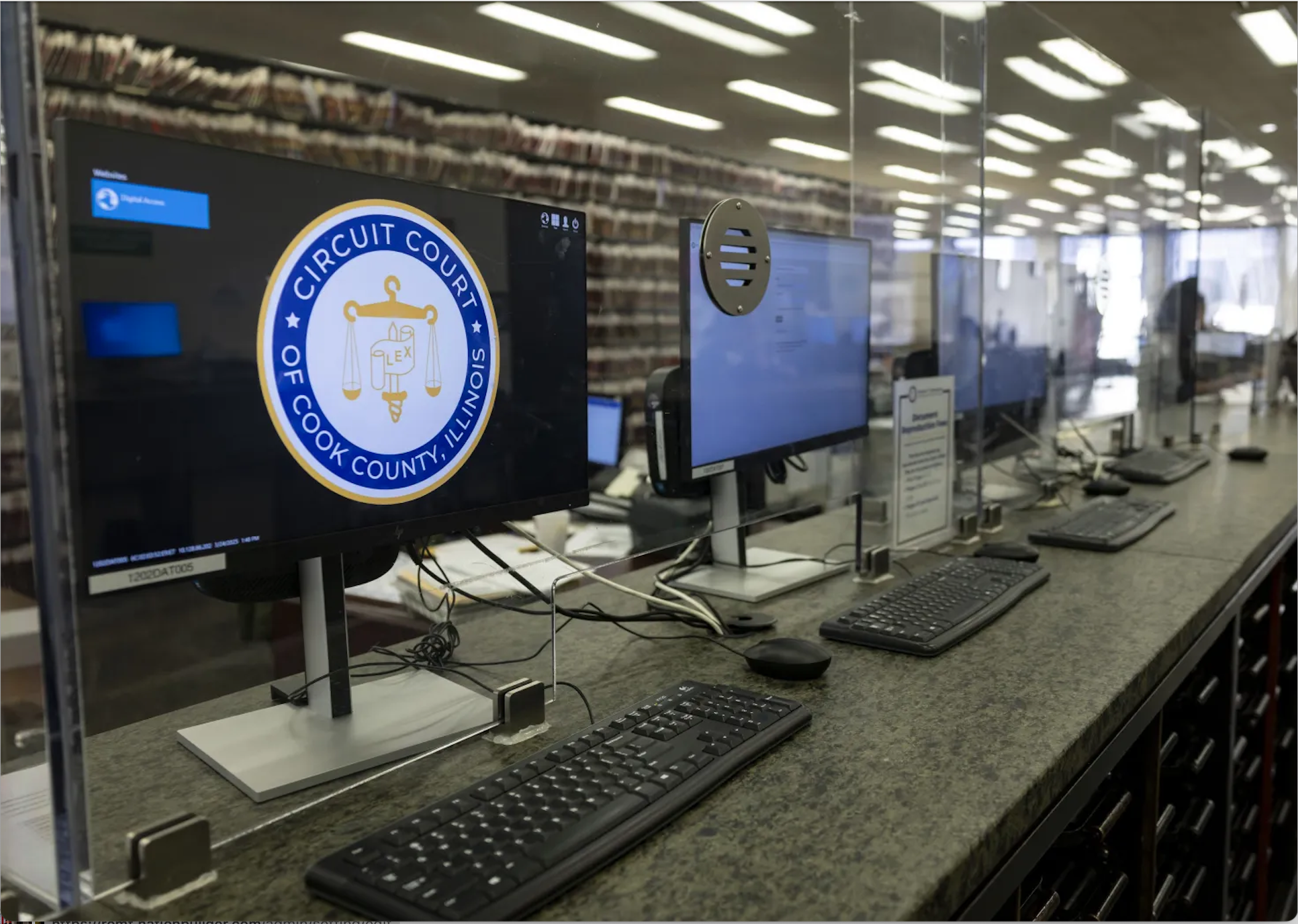
Computer terminals at the Probate Division of the Office of the Clerk of the Circuit Court of Cook County in the Daley Center in March. (Brian Cassella/Chicago Tribune)
Chicago Tribune Editorial - April 8, 2025
In 2015, the Cook County Circuit Court and the Illinois Supreme Court inked distinct deals with a Texas-based tech firm to overhaul their computer systems. A decade later, project costs — which were originally estimated to total $75 million — have more than tripled to over $250 million, with years in delays. A Tribune and Injustice Watch investigation uncovered how badly these Tyler Technologies deals have gone.
On paper, these projects promised transparency and efficiency — from digitized court filings to error-free property tax billing. But instead of modernization, we got bloated budgets, endless delays and glitchy systems.
Tyler, for its part, blamed the delays on shifting leadership and poorly staffed and under-resourced government clients — but the Tribune’s investigation tells a more complicated and troubling story of a firm that targets weakly supervised government contracts, where deadlines and oversight are often looser than in the private sector.
In a letter to Board President Toni Preckwinkle urging the county to sue to recover money from Tyler, Cook County Treasurer Maria Pappas called the county’s agreement “possibly the worst technology contract with a vendor that Cook County has ever written.”
“Clearly, giving Tyler any upfront money has made the County look foolish, inept stewards of the people’s money,” Pappas wrote. “However we do it, we must clean up the wreckage Cook County fostered when it signed this ill-advised contract with an arrogant and disinterested vendor.”
The county’s contractual structure led to additional expenditures. Preckwinkle didn’t fire Tyler, as Pappas urged — she hired an outside tech research firm to navigate the problem. Cook County ended up paying an extra $22 million for external consultants to oversee the troubled projects and $59 million to maintain legacy systems that were supposed to have been replaced.
To be fair, government tech projects are complicated, and overruns aren’t uncommon. But Tyler’s pattern of delays and missed benchmarks goes well beyond the norms..
This mess and the price tag for a lousy deal to clean it up are the sort of thing that gave rise to the chaotic Department of Government Efficiency and a broad appetite for slashing government spending. People don’t like it when their tax dollars are spent unwisely, and it makes them wonder what other problems are lying beneath the surface.
While Tyler’s tactics and weak execution are unacceptable, much of the blame has to be with the supervising officials who ended up with contracts that left them and their constituents vulnerable.
Why Tyler Technologies, we wonder, and not a tested firm such as Accenture, which has a significant Chicagoland presence?
Maybe Accenture would have cost more. But Tyler wasn’t a bargain in the end.
Worse, the contracts followed a history of political contributions dating back over two decades, including $25,000 in donations to various Cook County officials overseeing modernization efforts, according to the investigation.
There’s a lot to learn here for future agreements. The upfront payments to Tyler with little quality-based recourse represents a cautionary tale. Governments should implement stronger procurement processes, tighter contract terms, and tap independent watchdogs for major tech projects like these moving forward.
The lesson is clear: governments must be tough negotiators, not soft targets.
###
Tribune Editorial: Suburban speed cameras? Don’t replicate Chicago’s mistakes.

A speed camera monitors traffic on West Jackson Boulevard in Columbus Park on Dec. 30, 2024, in Chicago’s Austin neighborhood. (Brian Cassella/Chicago Tribune)
Chicago Tribune Editorial - April 7, 2025
Want speed cameras proliferating on your suburban roads?
Chicago-style speed cameras could be coming to a suburb near you thanks to a bill that’s still alive ahead of the April 11 third-reading deadline in Springfield. Today, cameras are allowed only in municipalities with populations over 1 million — which, in Illinois, means Chicago. If this new bill advances, it would authorize home-rule municipalities with populations over 35,000 in counties with more than 3 million people to install speed cameras.
Translation: Speed cameras could be coming to suburban Cook County, the only place in the state with municipalities that fit these requirements.
Red-light cameras are already a reality of life in some parts of the suburbs. From south suburban Homewood to northwest suburban Rolling Meadows, more towns are raising money from these cameras, plaguing drivers just trying to get to work, run errands or shuttle kids to activities.
Des Plaines operates red-light cameras at the busy intersection of Golf and Rand roads that issued 7,885 tickets last year, totaling $320,000.
Other suburbs leverage red-light cameras, too, including Hoffman Estates, also in the northwest suburbs.
Red-light cameras in west suburban Oakbrook Terrace were steeped in corruption, as former Oakbrook Terrace Mayor Anthony “Tony” Ragucci pleaded guilty in 2022 to his part in a kickback scheme involving the village’s red-light camera system.
Ragucci was just one of the elected officials caught up in corruption involving SafeSpeed LLC, which operated cameras in many suburbs. Former state Sen. Martin Sandoval, a Chicago Democrat, pleaded guilty in 2020 to accepting bribes to protect SafeSpeed’s interests in Springfield. Former state Rep. John O’Sullivan pleaded guilty in 2021 to accepting bribes to further SafeSpeed’s interests in Oak Lawn. The Tribune reported new information in February on Chicago Democrat and state Sen. Emil Jones III’s alleged role in the SafeSpeed scandal.
In short, the Chicago area has a history of red-light camera corruption.
That’s not to say all traffic camera programs are corrupt, but they certainly lend themselves to abuse. The public would benefit from far greater oversight of these expanding programs, given the history of widespread problems, not least of which is that partnering with for-profit camera companies can incentivize ticket volume over fairness or safety.
Our distrust of traffic cameras stems from this very problem, and past precedent makes us wary of expanding these programs. We’re also hesitant to support ideas that add yet another cost to everyday life.
We understand the impulse toward safety. Distracted, careless or intoxicated drivers have caused the deaths of many innocent passengers and pedestrians in the suburbs and beyond; reminders of these incidents can be found in the flowers, ribbons and other mementos meant to commemorate loved ones killed in these tragedies. Driving by these spots is a daily reminder of our responsibility to one another when we use the roads.
And yet the idea of the proliferation of speed cameras throughout the greater Chicago area makes us queasy, especially as we consider the failures of the city’s own speed camera program, including disproportional ticketing in Black and Hispanic neighborhoods.
As we’ve said before, we support drivers keeping to the speed limit and being mindful of others who share our roadways. But too often, we’ve seen that cameras are not about safety — they’re about money.
Before state lawmakers rush to replicate Chicago’s broken model, they should ask: Do we want real safety — or just a new stream of fines? We fear that emphasis is more squarely focused on the latter, and we encourage our Springfield officials to reject this legislation without the concurrent establishment of better oversight.
###
Jim Stinson: "With Thomas Homan, Americans can expect stronger borders and a clear plan to address illegal immigration."

"With Thomas Homan, Americans can expect stronger borders and a clear plan to address illegal immigration," said Stinson, Chairman. "Unlike Kamala Harris, infamous for her weak handling of illegal migration, Homan knows what it takes to keep America's borders safe. His background as acting ICE Director shows he's ready to take real action, not just make promises. Thomas Homan is the perfect pick for border czar, bringing unmatched experience and a proven tough approach to securing our nation."
On November 10, President-elect Donald Trump announced that Tom Homan would oversee border security and enforcement. According to a report from NPR on November 11, this role does not require Senate confirmation. Trump said in the announcement, "Likewise, Tom Homan will be in charge of all Deportation of Illegal Aliens back to their Country of Origin. There is nobody better at policing and controlling our Borders."
Homan's background includes serving as a police officer and an agent with U.S. Customs and Border Protection (CBP). He has worked under six presidents and was the executive associate director of enforcement removal operations for ICE during Obama's administration. NPR reports that he was involved in creating the family separation policy under Trump's first term.
Capitol News Illinois recently reported that a significant portion of Illinois' 2026 budget is allocated to supporting newly arrived migrants. This comes amid warnings from the Illinois Governor’s Office of Management and Budget about an impending $3 billion shortfall in fiscal year 2026. Representative Fred Crespo opposed the spending bill for the 2026 budget due to these financial concerns.
On November 18, ABC reported that Homan told Donald Trump Jr., during an appearance on Trump Jr.'s podcast, that there would be significant border action described as "shock and awe" starting on the first day of President-elect Trump's second term. "I'm excited. We're already working on these plans," said Homan during the podcast.
Stinson reiterated his support for Homan's appointment, stating that with his strong background as acting ICE Director, Homan offers Americans a clear and tough approach to border security. This stance contrasts sharply with Vice President Kamala Harris’s handling of illegal immigration issues, according to Stinson's statement to North Cook News on November 21.
Stinson: "Governor J.B. Pritzker has misled Illinoisans, claiming a balanced budget while leaving the state with mounting deficits"

James Stinson, Committeeman of the Republicans of Maine Township, reacted to the projected deficits for the 2026 fiscal year. He said, "Illinoisans deserve leaders who solve problems, not hide behind financial tricks that only make things worse."
"Governor J.B. Pritzker has misled Illinoisans, claiming a balanced budget while leaving the state with mounting deficits," said Stinson. "Instead of real fiscal reform, he relied on temporary COVID bailout funds, now exhausted. His promises of property tax relief through a millionaire surcharge were empty, as the deficits make such relief unlikely. Illinoisans deserve leaders who solve problems, not hide behind financial tricks that only make things worse."
In June, Governor J.B. Pritzker signed a $53.1 billion spending plan for the 2025-2026 fiscal year. According to Capitol News Illinois, this budget is considered the largest in state history. When he signed the budget, Pritzker described it as a "demonstration of ‘fiscal responsibility." He noted that $198 million would be added to the state’s rainy-day fund, bringing it to a record $2.2 billion. The budget will also make full payments into the state’s pension system and includes a tax credit for low-income families and higher wages for individuals who work with disabled people.
Capitol News Illinois reported that the tax credit for families will cost the state $50 million. The spending plan also allocates $811 million for healthcare, shelter, and other services for recently arrived migrants. It took legislators multiple attempts to pass the revenue bill, with warnings of an impending fiscal cliff from Representative Fred Crespo, a Democrat from Hoffman Estates; Crespo ultimately voted against the bill.
The administration denies issues related to population decline in Illinois. Despite data indicating otherwise, Deputy Governor Andy Manar said during a panel discussion with the Better Government Association that "there has never been more people living in the state of Illinois than there is today." According to an Oct. 19 report from The Center Square, Manar emphasized that Illinois is gaining population based on corrections from the Census Bureau's Post Enumeration Survey.
Stinson was first elected as Chairman of the Republicans of Maine Township in 2022. According to their website, he is focused on boosting Republican voter turnout, growing party membership, and communicating party positions on issues important to Maine Township voters.